Competitive Analysis Research · Honeywell · 2023
Technical Competitive Analysis for a new Product
Honeywell needed to identify market gaps for their new Predictive Maintenance module. As the UX Researcher for this module, I identified technical market gaps to influence positioning through competitive analysis.
- Company
- Honeywell
- Role
- UX Researcher II
- Duration
- 1.5 months
- Methods
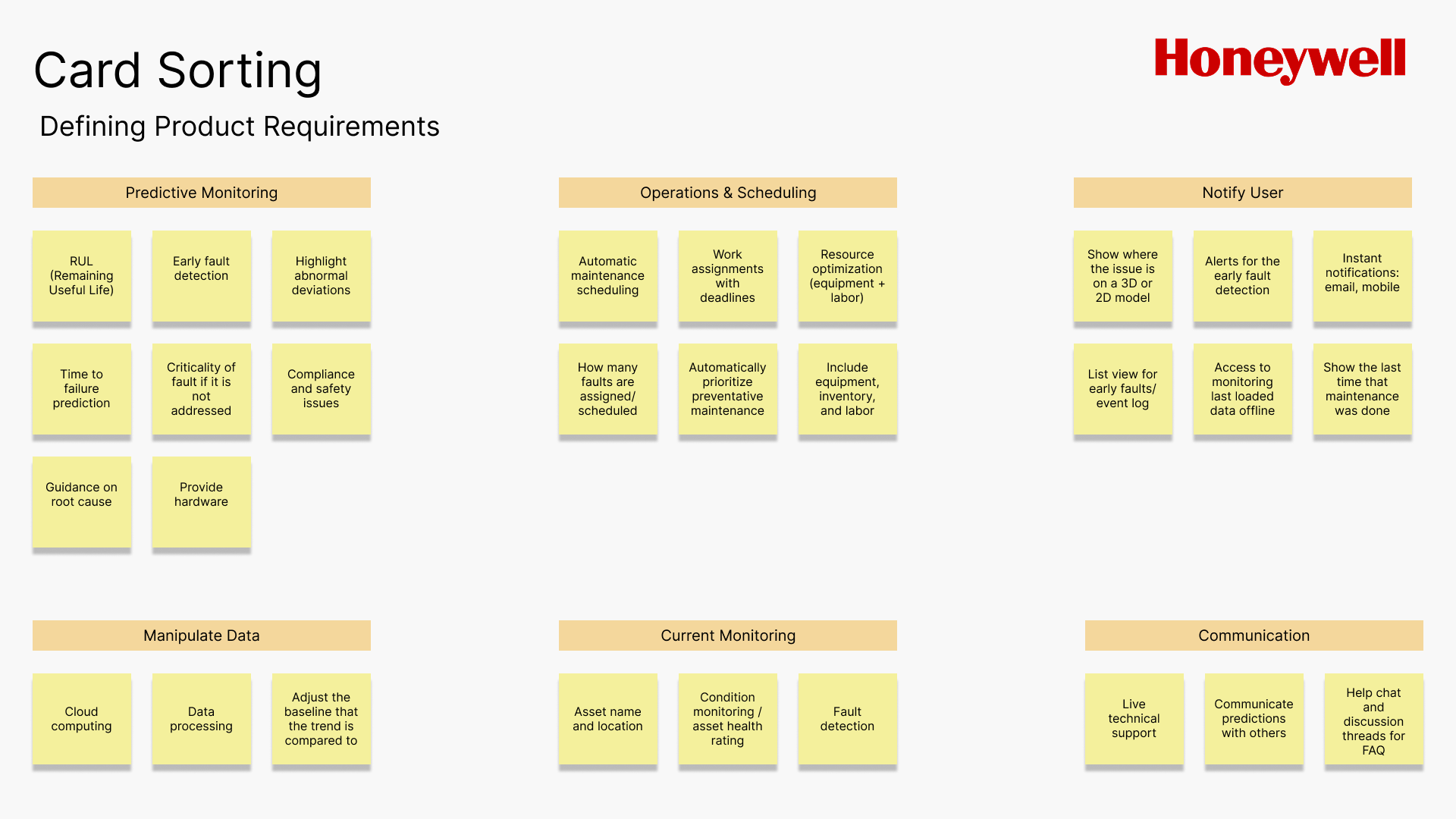
- Competitive Analysis · Define Product Requirements · Feature Prioritization · Stakeholder Management · Executive Presentation · Miro
Strategic Recommendation
Position around unplanned-downtime forecasting, not just asset health monitoring.
Business Outcome
Prioritized roadmap and go-to-market frame adopted by Product Management.
The Challenge
Problem statement and context.
Context
A new predictive maintenance module needed positioning. Six well-funded competitors were already in the space with overlapping feature sets.
Business Goal
Enter a crowded category with a defensible position and a prioritized 12-month roadmap.
Customer Problem
Buyers couldn't distinguish between vendors. Every deck showed the same asset-health dashboard.
Research
Understanding the domain.
Research Questions
- —What jobs are buyers actually hiring predictive maintenance to do?
- —Where do incumbents underdeliver?
- —Which capabilities are commoditized and which are differentiating?
Methods and Participants
Feature audit of 6 competitors · 8 interviews with operations leaders · Analyst report synthesis
Operations directors and reliability engineers across 3 verticals
Key Insights
Everyone sold asset health; no one sold downtime forecasting
5 of 6 competitors led with the same dashboard. Buyers described that view as "table stakes."
The buyer's real question was budget defense
Interviewees repeatedly asked "how do I justify the maintenance budget to my CFO?". A job no vendor was answering.
Strategy
Framing the solution.
Core Insight
The category had commoditized asset health. The unclaimed edge was translating asset data into financial forecasts a CFO would recognize.
Strategic Opportunities
- Downtime-cost forecasting as the flagship view
- Executive-ready reporting as a first-class feature, not an export
- Vertical-specific benchmarks as a moat
Recommendations
- Reframe positioning from monitoring to forecasting
- Prioritize financial-forecast features in the next two quarters
- Deprioritize dashboard parity work that would not differentiate
Decision Making
Design direction and validation.
Direction
Product leadership adopted the forecasting frame and restructured the roadmap around it.
Validation
Findings validated with three prospect customers in follow-up conversations.
Business Impact
What changed after the work shipped.
Actionable feature prioritization adopted by Product Management
New positioning frame used in subsequent sales conversations
Two roadmap items deprioritized based on competitive parity findings
Reflection
What I took from this engagement.
"The most useful research finding is often the one that gives a team permission to stop doing something."